

Labelled “messy and human”, and adopted by influencers and brands alike, it shows up as cluttered desks, half-drunk coffees, tangled wires, imperfect lighting, used empties. Casual clutter, carefully framed.
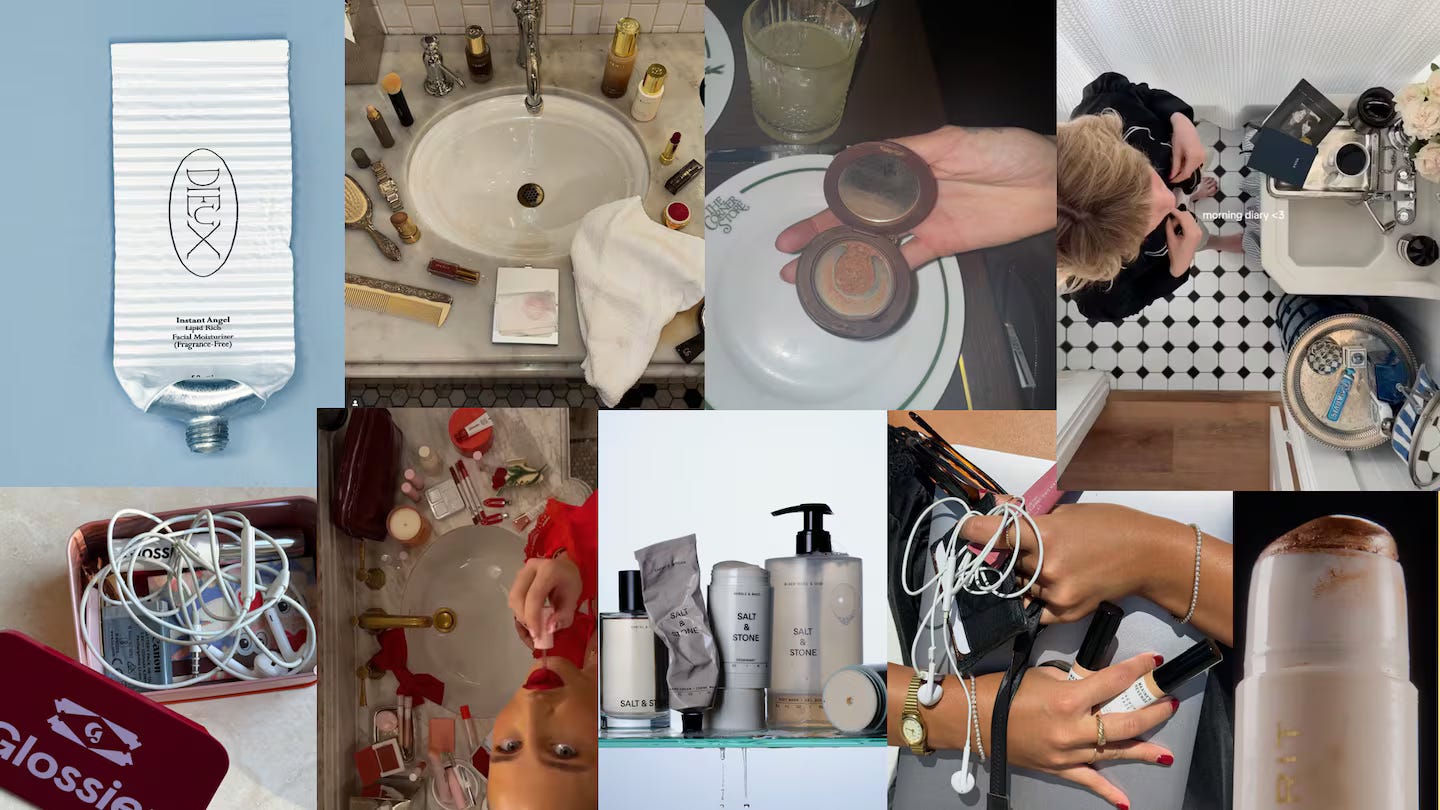
These images are intended to be read as proof of human creation and posting, of real life being shared. A cry out to escape AI generated content. They are meant to reassure us that what we’re seeing is real. That a person was there.
I understand the instinct. When polish becomes cheap, we reach for texture. When perfection feels suspect, we trust mess.
But here’s the uncomfortable turn.
Mess itself can now be prompted.
Not just copied, but convincingly generated. With all the right cues. The accidental composition. The casual clutter. The appearance of effortlessness. What once felt like proof of life is now just another style.
That’s where something quietly shifts.
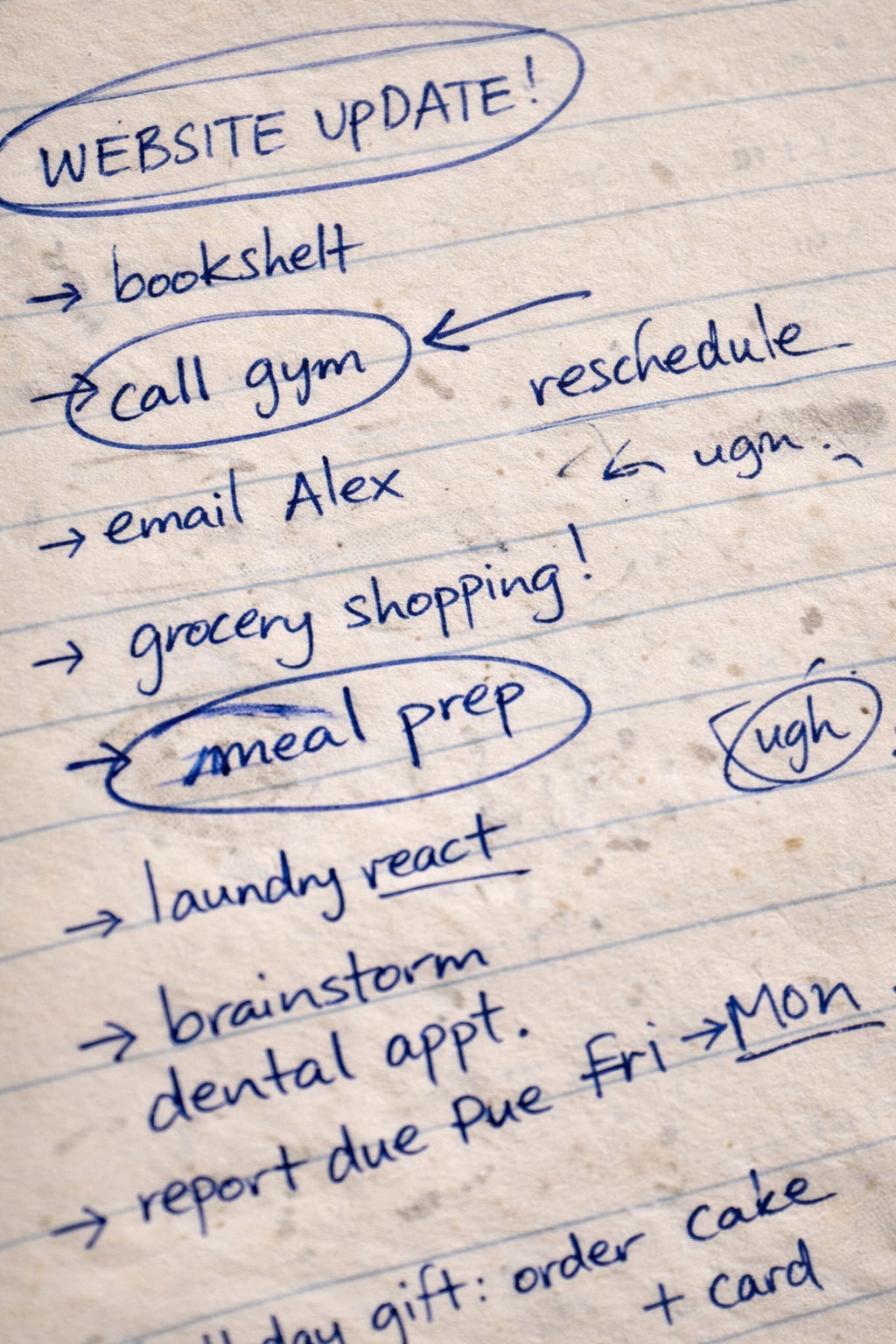
AI generated using this prompt: A macro photograph of a messy handwritten note on lined paper, written in blue ink with a ballpoint pen. The handwriting is slightly inconsistent in size and slant, appearing rushed but with the lines. Include subtle pen-pressure variations, slight paper smudging, and a few scratched-out words. The note is filled with to-do list items, arrows pointing to circled words, and marginalia. Realistic lighting from a slight angle,, 4k, no CGI look
Two stages of response
What’s striking is that many people are still responding as if we’re in an earlier phase.
Stage one is about proof.
People are trying to demonstrate humanness, and consuming content they believe signals it. Messy becomes meaningful. Imperfect becomes trustworthy. Texture becomes truth.
This makes sense. These signals worked for a long time.
Stage two is quieter, and more unsettling.
It’s the realisation that these same signals can now be generated just as easily. That the markers we’re relying on to identify one another in online spaces are no longer reliable.
The shift has already happened, but our shared understanding hasn’t caught up. The cost that once made these signals meaningful has collapsed faster than our ability to recognise it.
In that sense, much of what we’re seeing feels less like awareness and more like delay. Not denial as refusal, but denial as lag. People are still operating with a signalling system that no longer holds.
Why these signals stopped working
In economic theory, and later in communications and organisational studies, this dynamic sits within signalling theory, first formalised by economist Michael Spence in his work on information asymmetry.
Signalling theory looks at how observable traits or behaviours are used to signal underlying qualities in situations of information asymmetry. For a signal to function, it needs to be costly or difficult to fake. That cost is what gives the signal credibility.
Online, mess and imperfection functioned as signals of humanness precisely because they implied time, presence, and lived experience. They were not easily reproducible at scale, which made them meaningful.
But once those same markers can be generated cheaply and convincingly, they lose their signalling power. When a signal no longer carries cost, it can no longer reliably distinguish what it was meant to signal.
The breakdown here is not a failure of human judgement. It’s environmental. The conditions that once made these signals meaningful have changed.
Why this feels like a threshold
When any content can be generated, imperfection can be generated, and even proof of humanness can be generated, trust can no longer sit inside the feed.
It has to move elsewhere.
Into time.
Into consistency.
Into relationships.
Into reputation.
Into voice, presence, and embodiment.
Into things that cannot be instantly reproduced.
This is why there’s a renewed pull toward IRL experiences, smaller communities, slower media, and long-form thinking. Not as nostalgia, but as a structural response to a broken signalling environment.
The hidden cost
I’m not saying AI is bad.
I’m not saying this content is fake.
I’m not saying the trend isn’t a breath of fresh air.
What I am saying is that the audience is being pushed into a role they were never meant to occupy.
We’re no longer just consuming. We’re constantly, quietly verifying.
Who made this?
How was it made?
Why should I trust it?
That level of vigilance is cognitively exhausting. Historically, systems don’t survive that unchanged.
Social platforms were built on the assumption that authorship was legible. That you didn’t need to interrogate every artefact for signs of human life. When that assumption breaks, the system doesn’t end. It mutates.
The uncanny part
We’re not failing to read the signals.
The signals are failing.
And when that happens, people don’t just lose trust in content. They lose trust in the environment that trained them to read it.
That’s why this moment feels heavier than a trend cycle. It’s not about AI images versus real ones. It’s about what happens when the markers we rely on to recognise one another stop working.
A quiet threshold
I don’t think this is the end of social media. But it may be the end of a particular assumption. That authenticity is immediately legible. That reality can be read at a glance online.
When humanness becomes something you have to signal rather than something that’s assumed, you’ve crossed into a new phase.
And we’re only just learning how to live there.