

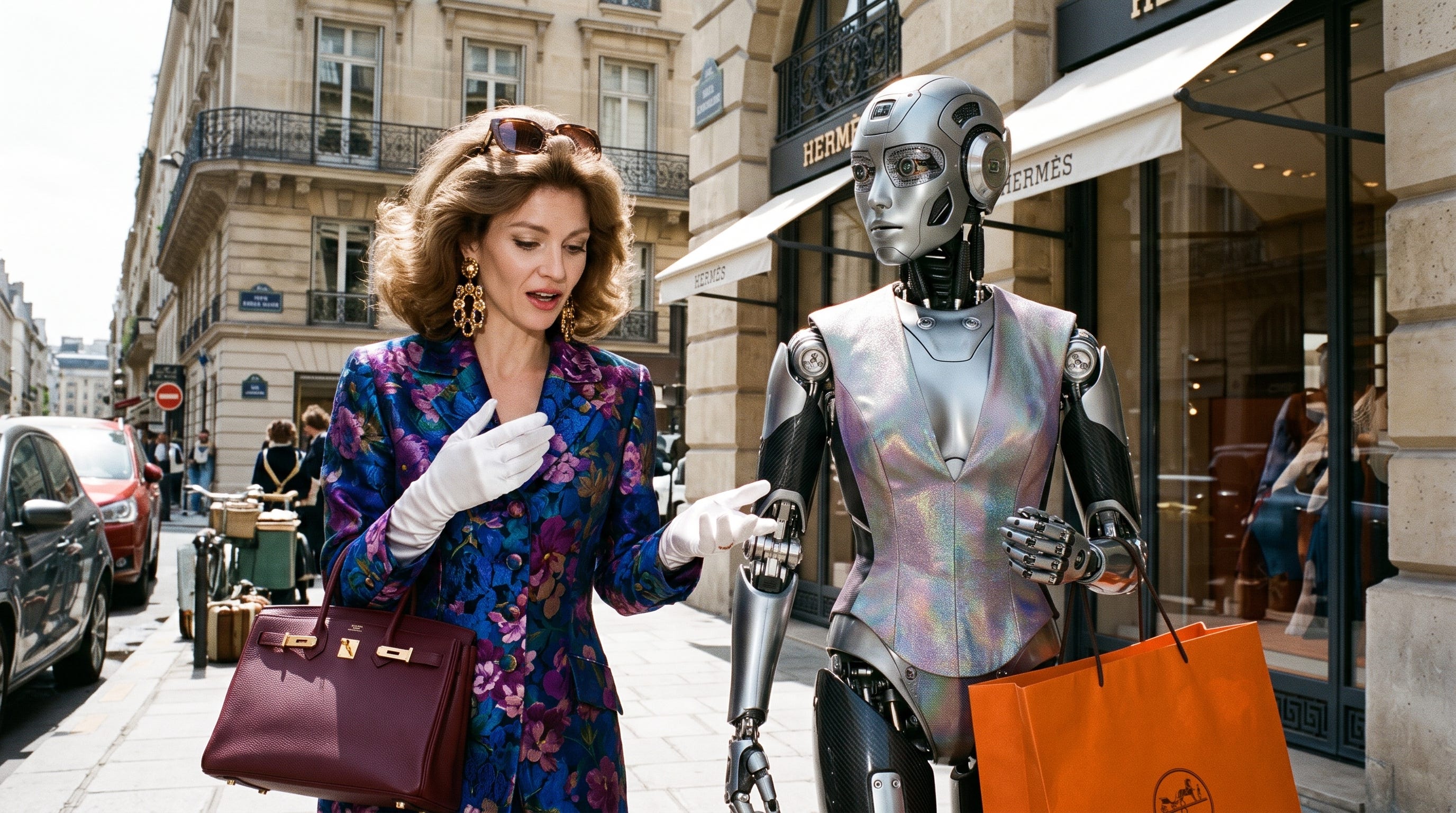
One caveat before we jump in: I’m working with an AI on these pieces now (shock, horror). You probably know this already. I’ve never claimed to be much of a writer. I am, however, a deep thinker, and I recognise patterns (I can’t turn it off; thanks, ADHD). So I work with Claude (and others) to help me research, and to structure and challenge my thinking. I see it as a writing partner for a skill I feel weaker in, and I’ve learnt a lot from doing it. The most important thing for me is this: the ideas start with me, and the point of view is always my own.
Let’s jump in…
Think about the last big fragrance launch you saw. A famous face, golden light, a slow-motion turn of the head, a billboard on Sheikh Zayed Road. It’s about as pure a piece of promise-making as marketing gets: a feeling, a version of yourself you’re meant to want. I’m not above it. That kind of thing works on me, and it works on most of us.
Now picture a different shopper. She opens ChatGPT and types: which perfume has the best sillage in Dubai heat? I want people to notice it when I walk past.

That’s the shift I keep coming back to )please see below for proof of real human thinking about this). For most of history you sold to one kind of buyer, a person, and the whole machinery of advertising was built to make that person feel something. Now there’s a second buyer, one that reads everything, feels nothing, and more and more often decides what the human sees first.
So, who are you selling to?
The honest answer for almost everyone is: both. And they want completely different things.
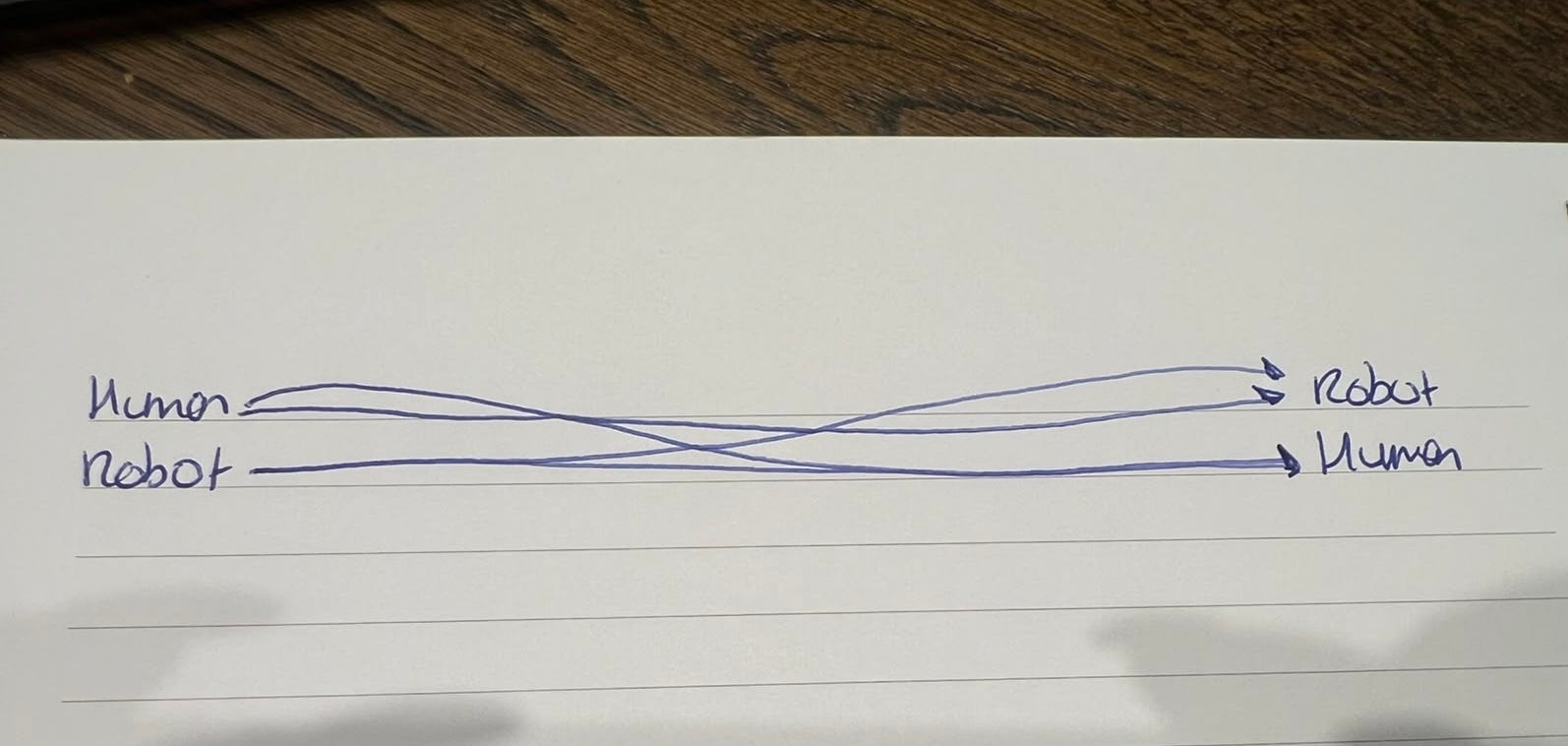
My crazy doodling trying to figure out who is selling to who, and how
The promise and the proof
Let me put it as plainly as I can, because everything else in this piece hangs off it.
People buy the promise. Who will I be if I own this? How will it make me feel? Will people like me, or people I’d like to be, see it on me? Status, desire, belonging, identity, and mostly at a subconscious level. Brands spend fortunes on this because it works.
Machines buy the proof. Not proof in a legal sense, but whatever they read as evidence: ratings, review volume, consistent facts, independent mentions, clear specs, a price that’s actually the price. An AI assistant has no ego to flatter and nothing to signal to anyone. It wants to give a good answer and not get it wrong.
We now have some research on what moves these agents, and it’s quite revealing. A team of researchers built a test marketplace and watched how AI shopping agents from the big labs chose between products (the paper is called What Is Your AI Agent Buying?). A few findings stood out to me:
Labelling something “sponsored” made agents less likely to pick it. Every model did this. The paid badge that works on a scrolling human works slightly against you with a machine.
A platform’s “Overall Pick” badge did the opposite, and by a lot. A product picked 10% of the time jumped to somewhere between 20% and 43%, depending on the model. Third-party endorsement is gold.
A tenth of a star mattered. Raising a product’s rating by just 0.1 took it from 10% to as much as 20% of picks. Review count mattered too.
Rewriting the product description helped, in most models. When the researchers let a seller-side AI tweak descriptions to better answer the shopper’s question, the product’s share went up by as much as 15 points.
The machines don’t agree with each other, and they change their minds. In one category, a fitness tracker was chosen 77% of the time by one model and 6% by another. A model update can reshuffle the whole picture.
So what does this tell us? The machine isn’t a neutral judge. It has habits of its own, and they can change every time the model is updated. But look at what those habits reward: someone else vouching for you, a strong rating, plenty of reviews, a description that actually answers the question. Then look at what they punish, which is the thing you paid to promote. With people, money can buy you attention. With a machine, it mostly can’t. What gets you picked is what other people say about you, and how clearly you’ve explained what you do.

Why the promise worked, and why it’s wobbling
There’s a reason the glossy campaign worked for so long, and Oliver Feldwick explains it brilliantly in “Cheap Talk and Costly Signalling“, from his Substack Scraps, Straws and Silicon. His argument, in short: a lot of marketing has worked as a costly signal. We trust a message more when it would have been expensive to fake.
You can see this all over Dubai. In 2023, the number plate P7 sold for AED 55 million at a charity auction. Nobody needs a two-character plate to get to the mall. It means something because almost nobody could afford it. If anyone could have one, it would say nothing at all.
Advertising worked the same way. A huge campaign didn’t just tell you about the perfume. It told you the brand was big enough, and confident enough, to spend that kind of money. The celebrity face, the Paris show, fireworks over the Burj. Money you could see, standing in for quality you couldn’t.
AI is squeezing this from both ends.
It’s now cheap to look expensive. A campaign that looks like it cost millions can be made in an afternoon, so looking expensive doesn’t tell you much any more. Creators are feeling this too. When anyone can make a beautiful carousel in five minutes, a beautiful carousel no longer proves you put the work in.
And the machine doesn’t care about that type of signalling. People used the size of a campaign as a shortcut for “this must be good”. An AI agent doesn’t need shortcuts. It reads the reviews, the return complaints and the price, so the money spent on looking impressive barely registers.
So the promise is being squeezed by the people making it and by the machines reading it. That doesn’t make the fancy signalling extinct, It means the kind of effort that convinces people is changing, and I’ll come back to what that looks like at the end.
Five ways selling works now
When I first mapped this, I came up with five different ways buying and selling now happen. Each one has a different buyer, and each buyer responds to something different.
1. Human to human: still buys the promise
The market stall never went away. People buy from people, and they want connection, emotion and a sense of belonging.
You might expect AI to make this matter less. It’s doing the opposite. In a Gartner survey published in September, 43% of US consumers said they now rely more on real people for shopping advice because there’s so much AI content around. 57% said AI-made brand content had made them trust brand messaging less. And 35% said they rely on influencers less.
I don’t read that last number as people giving up on creators. I read it as people giving up on content that feels like it was made by nobody. When anything can be made in seconds, the thing you can’t fake is a person who keeps showing up.
Communities show this more clearly than anything. When a fan spends weeks making something for a brand or a person they love, that effort is proof no budget can buy. It’s also why audiences turn on AI-made work so fast when they feel misled. They weren’t only buying the thing. They were buying the care that went into it.
2. Humans to machines: getting found and getting cited
If people ask an AI what to buy, you have to be visible to the AI first. The industry calls this GEO or AEO, generative or answer engine optimisation. Think of it as SEO where the reader is a machine that summarises, rather than a search engine that lists.
Bain and the Comité Colbert found in June that around 70% of luxury shopping prompts don’t name a brand at the start. People ask “what’s a good first fine-jewellery piece?”, not “Cartier”. And 90% of the links AI tools cited came from outside the brands’ own websites.
Read that again. Nine in ten. What the machine believes about you is mostly what other people have said about you.
As someone who came up through PR and publishing, this is the bit that made me sit up. A feature in a respected title, a detailed review, an expert quote, a long Reddit thread. These used to be about the humans who read them. Now they’re also what the machines read and repeat to millions of people asking for advice. Press has become reputation a machine can read.
3. Machine to human: the AI as salesperson
This one’s already big. Amazon says its shopping assistant Rufus was used by 300 million customers in 2025 and added close to $12 billion in sales that wouldn’t otherwise have happened.
And the people AI sends your way are good customers. Adobe’s July figures show visits from AI tools now convert 60% better than other traffic. Shopify said in its Q2 results that orders coming from AI search had tripled on the year before, and that AI channels were bringing in new buyers at about twice the rate of Google, social or direct.
A year ago, AI traffic converted worse than everything else. That flipped in about twelve months.
4. Machine to machine: buys certainty
What happens when one AI agent buys from another, with no human watching in the moment? The pipes for this are being laid fast: payment standards from OpenAI and Stripe, from Google and Shopify, and a “know your agent” framework from Visa, Mastercard and Ant International that’s basically ID checks for bots.
It’s early. OpenAI quietly retired its in-chat checkout in March after very few merchants went live. The rails are ahead of the trains, which is normal.
But it tells you what machines want from a seller, and none of it is aesthetic:
Certainty. Accurate prices, live stock, clear delivery times.
Readability. Product information laid out so a machine can use it.
Verification. Proof you are who you say you are.
Accountability. A clear answer to who fixes it if it goes wrong.
My bet is that reputation becomes a kind of currency between agents. Something like a credit score for whether a business does what it says.
5. Humans to humans, through agents: the doorman
This is the one I think most brands are missing, and it matters most for luxury, wellness and personal brands.
It isn’t really robots selling. It’s still a person buying from a person or a brand they love. But there’s now an agent standing in the doorway.
The agent picks the shortlist. The human picks the winner.
You can see it already. Adyen found the share of US shoppers using AI assistants nearly tripled in a year, from 12% to 35%. Bain found 82% of top-spending luxury customers used an AI tool before their latest purchase, and 47% of people who bought in store had used AI before they walked in.
The Gulf is further along than most. In Checkout.com’s survey this spring, 79% of UAE shoppers said they’re comfortable letting an AI agent complete a purchase for them, and 71% would let it switch brands if it found better value. That second number should worry any brand that’s relying on loyalty alone.
So you have to win twice. You win the agent with proof, and you win the human with the promise. Fail the first and you never make the shortlist. Fail the second and you make the shortlist and still lose.
There’s one way past the doorman, and Oliver makes this point well: be the name. If someone tells their agent “get me a scented candle”, the agent goes off and compares forty of them. If they say “get me a Diptyque candle”, it doesn’t compare anything. It just goes and gets it. The brands and people who get named, rather than described by their category, skip the shortlist altogether.
Who does the agent work for?
Here’s where it gets uncomfortable, and where I think the next few years get decided.
The optimistic version of all this is lovely. Everyone gets a personal shopper who has read every review ever written and has no commission to earn. Something that quickly finds the thing that’s actually good, rather than the thing that shouted loudest.
But that only works if the agent is really on your side. And the company that builds the agent gets a say in what goes on the shelf.
You can already see the fight. Amazon started letting brands pay for sponsored prompts inside Rufus last November, so the friendly assistant is now partly an ad with a nice voice. In September, Amazon blocked Meta’s new shopping agent, Muse, from its site, saying it hadn’t identified itself as a bot. It has been in a legal fight with Perplexity over the same thing. Nobody wants to be the shelf another company’s robot shops from.
People can sense this. In Adyen’s research, 41% of shoppers said they want to know why an AI picked one product over another. I think “whose side is your agent on?” is going to become one of the defining consumer questions of the next decade. I’d like it to be answered properly, in the open, rather than buried in terms and conditions.
Good news for small brands?
Maybe. I’m cautiously optimistic.
If machines lean on evidence rather than budget, a small brand with a better product and real reviews has a better chance than it’s ever had. Analysis from Peec AI found that one indie skincare brand, Kaja Beauty, picked up 4.2% of all skincare citations across the big AI platforms. That’s almost level with Wikipedia. A small brand can win this.
Better products beating bigger marketing budgets. I’d love that world.
Two catches, though.
Proof can be faked. If machines reward reviews, ratings and “independent” mentions, people will manufacture all three. Fake reviews, paid placements dressed up as editorial, invented test results. The machines will have to get better at telling real proof from staged proof, and some of the early ones won’t be.
There’s no single top spot to chase. Because different AIs prefer different things, and change their minds with every update, there’s no trick that holds. The only strategy that survives is real proof, built over time, in lots of places.
Delegated or desired?
Underneath all of this, I think buying is splitting in two.
Delegated purchases are things you don’t want to think about. Washing-up liquid, printer ink, the vitamins you reorder every month. Agents will take these over, and fast. The brand that wins is the one the agent trusts and finds easy to buy from.
Desired purchases are about who you are, or who you want to be. The bag, the ring, the hotel, the holiday. Nobody wants a bot to buy their first Birkin. The wanting is the point.
Luxury and personal brands live almost entirely in the second group. But even there, the agent decides whether you make it onto the list.
Oliver has a really useful way to sort this, with two questions. Can a machine check whether it’s any good? And does anyone see you choose it?
Checkable, and nobody sees (a phone charger, a water filter): the agent decides. Your job is to make the shortlist.
Checkable, but people see your choice (sunglasses, a gym bag): the agent filters, the human picks. Being recognisable still counts.
Hard to check, and private (a coach, a consultant): what you’re willing to put on the line does the work.
Seen, and decided by taste (a handbag, a fragrance): this is where the big, visible signal still holds up best.
From showing effort to showing stake
Oliver’s answer to all this, and I think he’s right, is that trust is shifting from proof of effort to proof of stake. The question is no longer how hard you worked. It’s what you stand to lose if you’re wrong.
Guarantees are the clearest example. Patagonia has long promised to repair, replace or refund anything that doesn’t perform. That would be ruinous if the products were poor, which is exactly why people believe it. A coach who says “if you don’t get results, you don’t pay” tells you more than any glossy sales page.
Making is cheap now. These are the things that still cost something, so they’re the things that still convince people:
Put something on the line. Make claims specific enough to be wrong. Offer guarantees. Put your name on the work. A promise only counts if breaking it would hurt.
Be in the room. Events, dinners, live sessions, showing the thing working in front of people. Time and presence can’t be generated. (It’s a big part of why I’m launching in person events again soon.)
Show your workings. How you made it, the decisions you took and why, and where AI helped. Being upfront about how you use AI lands far better than being found out.
Edit. Anyone can produce ten thousand words now. Choosing the three hundred that matter is the skill.
Build a track record. Years of turning up and doing what you said you’d do. It’s the one thing you can’t shortcut.
And for the machines specifically:
Ask them about yourself. Once a month, ask ChatGPT, Claude, Gemini and Perplexity the questions your customers would ask. Not “tell me about [your name]”, but “who’s the best [what you do] in [your city]?” Notice who comes up and what sources they cite. That’s your new shelf.
Make your proof easy to read. Results, reviews, credentials, prices, what you actually do, said clearly and the same way everywhere. If a machine has to guess about you, it’ll pick someone it doesn’t have to guess about.
Get talked about where machines listen. Press, podcasts, YouTube, Reddit, LinkedIn, guest essays, reviews. Other people’s words about you count for far more than your own.
Own the relationship. Your email list, your community, your clients. Adyen found 27% of retailers already worry about losing the direct relationship to AI. The doorman can’t stand between you and people who already know your name.
None of this means desire is going to disappear. The proof gets you on the AI agents results, and a the promise, backed by something real, is still what makes someone choose you once you’re there.
So, who are you selling to?
Sources
Allouah et al., What Is Your AI Agent Buying? Evaluation, Biases, Model Dependence, & Emerging Implications for Agentic E-Commerce — arXiv 2508.02630
Gartner consumer survey on AI and influencers (1,006 US consumers), 22 Sept 2026 — Gartner
Bain & Company and Comité Colbert, Luxury and Technology report, 30 June 2026 — Bain
Peec AI / 5WPR, State of AI Citations 2026 — 5WPR
Amazon Rufus figures — Modern Retail, 30 Apr 2026
Adobe AI traffic data, July 2026 — Digital Commerce 360
Shopify Q2 2026 results, AI orders and new buyers — SaaStr
Agentic commerce protocols, Sept 2026 update — toomanysecrets.com
Adyen Retail Report 2026, US — Adyen
Checkout.com, Agentic Commerce 2026 (UAE figures) — Zawya
Amazon blocks Meta’s Muse agent, 22 Sept 2026 — VKTR
Oliver Feldwick, “Cheap Talk and Costly Signalling”, Scraps, Straws and Silicon, 28 Oct 2026 — Substack
P7 number plate, Most Noble Numbers charity auction, April 2023 — Gulf News