

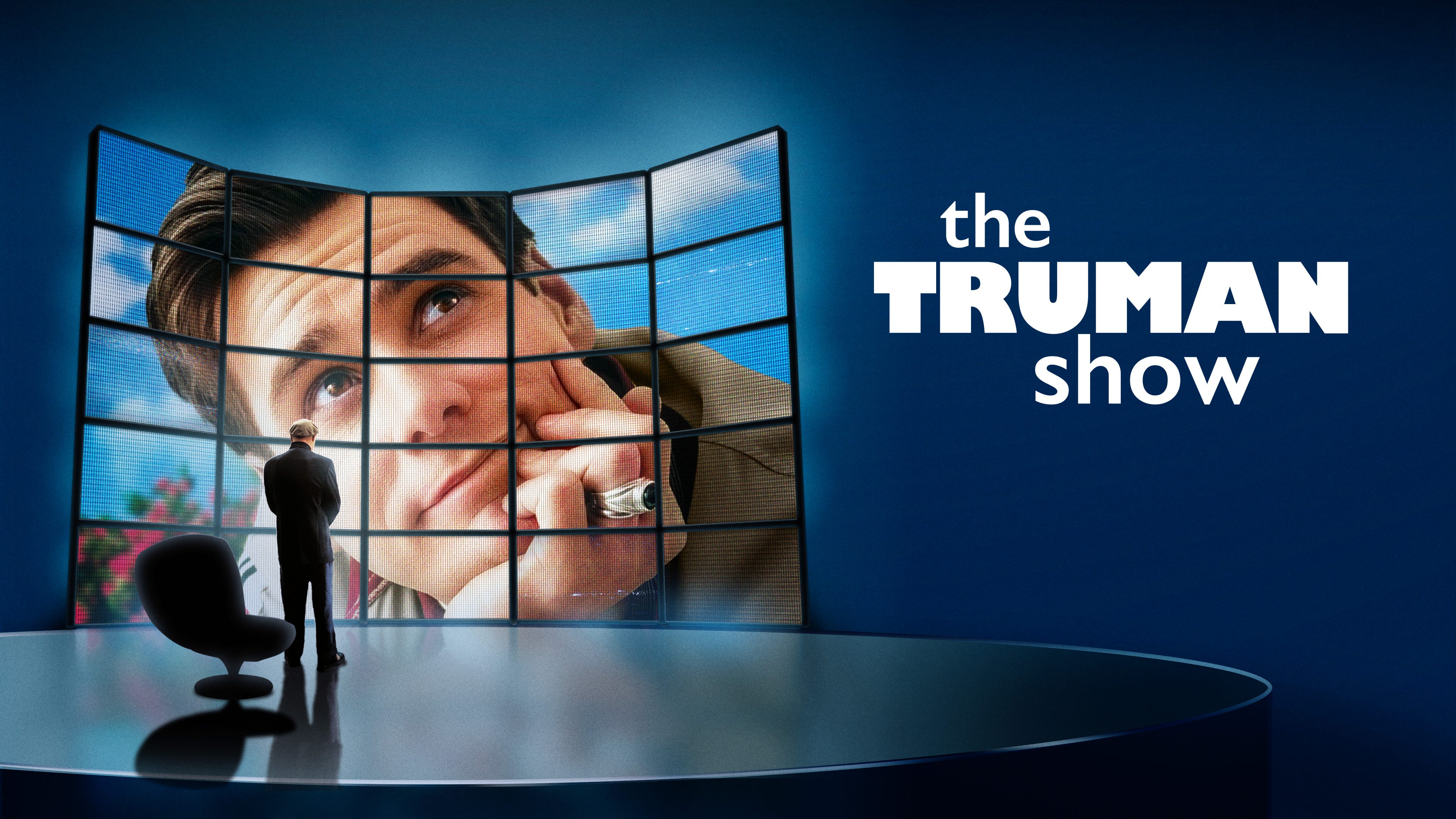
If you’re here because you commented “Truman Show” on the Reel, welcome. This is the longer version.
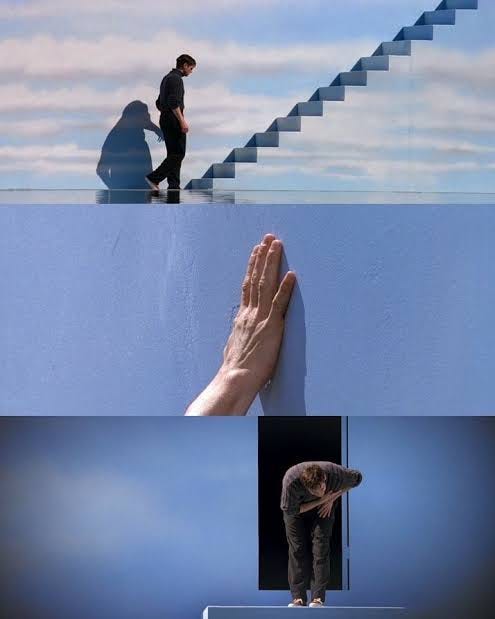
At the end of The Truman Show, Truman walks up a staircase painted onto the sky, finds a door and steps out into the dark. The audience in the film cheers, and so do we. After a lifetime on air, Truman has found the one place the cameras don't reach.
I’ve started to think most creators have bricked that door up. And I think that’s where the ick comes from. Let me explain.
Front stage, back stage
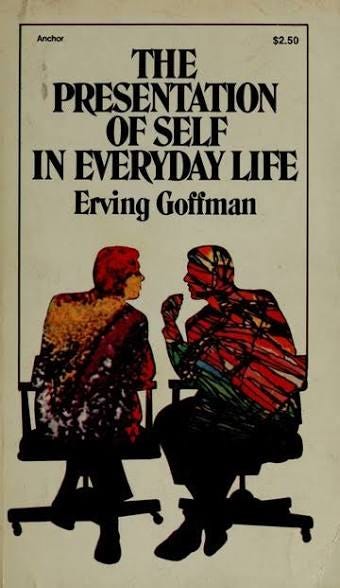
In The Presentation of Self in Everyday Life (1959), the sociologist Erving Goffman argued that we all run two versions of ourselves. There’s the front stage self we perform for other people, at work, at dinner, on a first date. Then there’s the back stage, where the performance drops: the car after the meeting, the kitchen after the guests have gone home, the group chat about the meeting.
The back stage is what makes the front stage possible. You can perform all day because there’s somewhere you don’t have to.
Being a creator doesn’t have to get rid of the back stage, but it puts all of it up for grabs. Your morning coffee could become a ‘get ready with me’. A quiet Sunday could be a ‘reset routine’. A breakup could become a ‘storytime’ with three lessons at the end. Whether you actually post it almost doesn’t matter, because your audience knows you could. And once anything might be content, it gets hard to tell which parts of you are real. Even the “real me, no filter” post has been filmed, edited and captioned before anyone sees it. It can be just as much of a mind screw for the creator as it is the viewer.
When it stops being a metaphor
There’s a documented psychiatric phenomenon called the Truman Show delusion. The psychiatrist Joel Gold and his brother Ian, a philosopher, named it in the late 2000s after seeing patients who believed their lives were being secretly filmed and broadcast.
In February 2026, a case report in the journal Future Health described a 30-year-old social media influencer who developed it after a sharp drop in her engagement and a public falling-out with a close collaborator. She became convinced her home was full of hidden cameras. With treatment, including a supervised step back from social media, she recovered within weeks.
She’s one case, and psychosis is complicated, with causes that go well beyond social media. But the shape of it stayed with me.
Most creators are nowhere near that. They’re just doing a milder version of it, on purpose, every day.
So what is ‘the ick’?
People assume it’s vanity: the ring light, the ‘self-obsession’. I don’t buy it. Plenty of vain people are very charming, and we are all a little bit vain.
I think the ick is a trust problem. When someone shares their life for a living, you can never be sure whether what they’re showing you is real or made for the camera. Even when they open up, part of you wonders if it’s content. That doubt is what puts people off. It isn’t really about vanity. It’s not being able to tell where the person ends and the content begins.
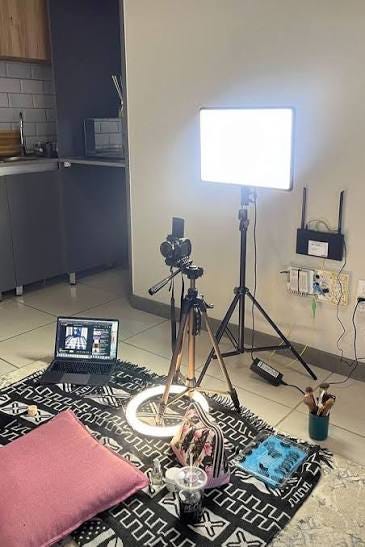
It helps to remember how recently filming in public became normal. Before 2020, if you set up a phone and started talking to it on the street, people stared. It looked odd, and a bit embarrassing.
Goffman had a name for the rule it broke: civil inattention. When we pass strangers in public, we usually glance at them briefly to show we’ve noticed them, then look away to show we’re not going to intrude. It’s a small, unspoken agreement. I see you, and I’ll leave you alone. It’s a large part of why public spaces feel comfortable.
Filming yourself for social media breaks that agreement in two ways. You’re performing in a space where nobody asked to watch, so passers-by become an audience they never signed up to be. And you’re pointing a camera at a place full of people who might end up in your video without knowing. The strange looks were people noticing that the usual rules had been broken.
Then the pandemic happened. Lockdowns pushed people onto TikTok, Instagram launched Reels in August 2020, and short video became one of the main ways people found out about the world. Somewhere in that period the public mood flipped. Filming “silly little videos” stopped looking strange and started looking like work, and sometimes very well-paid work.
The bigger shift was in direction. We used to use the internet to document real life. Now real life is often arranged for the internet: the restaurant is picked for how it films and the trip is planned around the content. The offline world became raw material for the online one, which is exactly why it’s so hard to tell what’s real.
And once filming your life became work, it came with a pay cheque. That’s the other layer of the ick. A lot of people wouldn’t feel comfortable putting their life online to earn from it: their relationship, their home, their kids, their bad days. To them, it feels like something that shouldn’t be for sale. So when they watch someone else do it, and get paid well for it, the discomfort is partly a moral one.
And the money can be huge. The biggest creators can earn more from a single brand deal than most people earn in a year. That lands differently right now, when so many careers feel unstable. People are being made redundant, graduates are struggling to find entry-level jobs, and AI has a lot of people wondering whether their work will still exist in five years, hell, maybe even one year. If you’ve done everything you were told to do and still feel insecure at work, watching someone get paid to film their morning routine can feel ‘unfair’. I think some of the ick is that. It’s not quite jealousy. It’s more a sense that the rewards don’t match the effort, or the values, many people were brought up with.
Keep a door
If you’re building a personal brand, this is the most useful advice I have, and it’s the least strategic thing I’ll ever tell you. Decide what is never content. It can be different for each person but for example: a relationship, a hobby, a friend, your family dynamic. Protect it for your own head first.
Funnily enough, it makes the content better too. People can feel the difference between someone performing their whole life and someone choosing what to share.
You don’t have to walk off the set like Truman. You just need to know where the door is and go through it often.
If any of this feels uncomfortably close to home, it’s worth talking to someone you trust or a professional. Being watched for a living takes a toll, and plenty of creators feel it.
Sources
The “Truman Show” delusion: life as a reality TV show — ScienceDaily, 2012
Erving Goffman, The Presentation of Self in Everyday Life (1959)